

Want high yield on stablecoins? Two common paths show up often: chase subsidies—rotate farms, mint new emissions, bridge everywhere, and leave when APY collapses—or park funds in opaque “high-yield” products and hope you exit before the blow-up. There is a third path: build an explainable yield structure in your own wallet—no manager, no management fee.
Based on a publicly disclosed Hyperliquid live book and a companion open-source repository, this outlet maps the logic, data conventions, operating steps, and risks of an HYPE funding-rate carry. Return figures below come from that disclosed window; they are not promises from this outlet and are not investment advice.
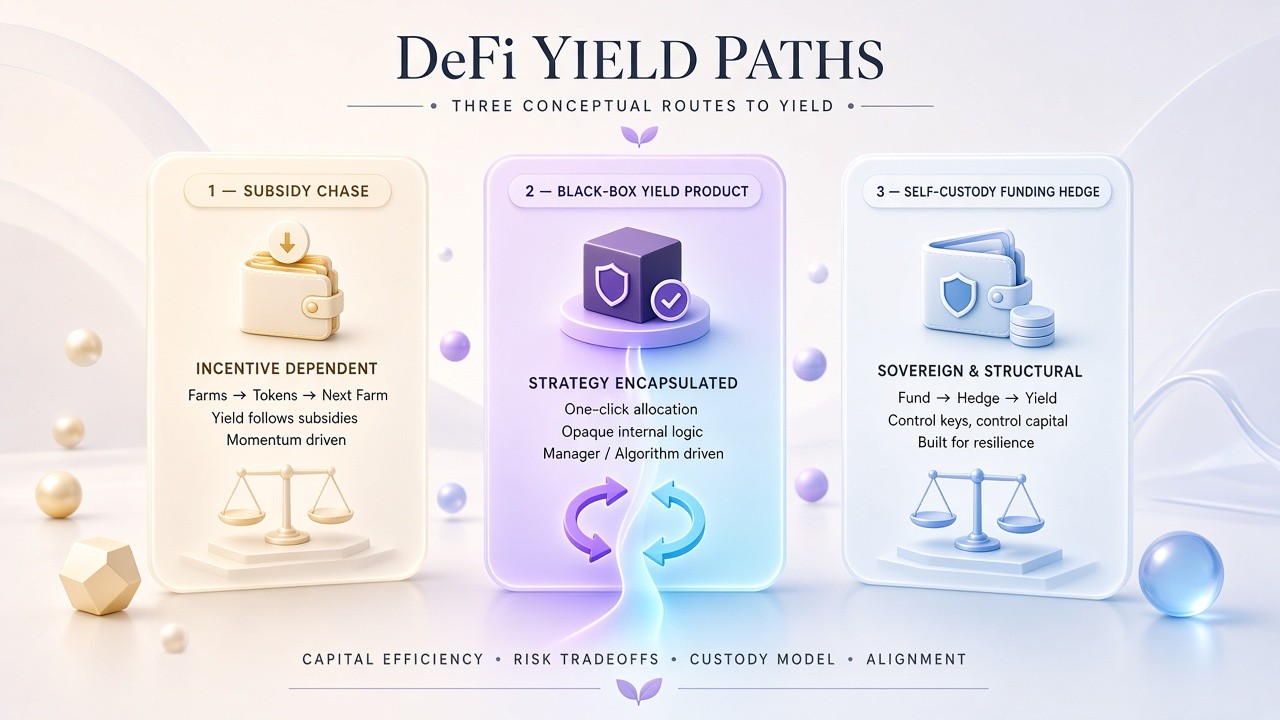
1. Open the product: where does the yield come from?
Over the past stretch, on-chain yield-bearing stables and “earn” products have usually drawn return from three buckets:
- Protocol subsidies: the most direct—and the most temporary. When the campaign ends, the yield collapses.
- Transparent on-chain strategies: lending, funding-rate arb, trackable DEX trading, and similar structures with a relatively auditable chain of custody.
- Opaque off-chain strategies: private credit, off-chain wrappers, CEX trading books (hard to pierce once funds enter an exchange), plus models that lean on audits and issuer narratives.
Managed products package strategy, execution, and day-to-day risk control: you deposit; the manager allocates, executes, and reports a yield. Convenience has a cost—capital often crosses several layers, sometimes split across venues at the same layer. Every layer asks for trust; a failure at any layer can hit principal.
Some of those structures are not that complex. You can run them in your own wallet—cut the middle layers, and skip management fees and performance cuts.
2. The third path: long spot + short perp, collect funding
Per a public live disclosure, one team used a relatively low-barrier funding carry: buy HYPE spot, short an equal-size perpetual, hedge price moves with the two legs, and mainly earn funding.
The account ran self-custodied on Hyperliquid. The disclosed window was 29 Jul 2026 to 13 Oct 2026, about 76 days: strategy NAV reportedly rose 2.45%, implying a historical APY near 12.33%; daily-NAV max drawdown about 0.17%, annualized volatility about 1.55%, Sharpe about 4.2 (daily NAV, 5% risk-free rate). Those are historical results from that disclosure—not a guarantee of future returns.
On-chain positions and activity are publicly checkable. In browsers such as hl.eco, the Positions tab usually shows only the perpetual short (spot gains offset short mark-to-market); HYPE spot appears under Lending as Supply.
In the same period, a large public Hyperliquid USDC-borrow address ran a similar structure: roughly 693k HYPE spot hedged by about 648k HYPE perp short, short notional near $52.71m, USDC borrow near $35.47m; most spot covered by the short, leverage around 1.75x, with outside estimates putting yield in a ~14% ballpark. That is a capacity reference—tens of millions of dollars notionally may not instantly crack liquidity in this market.
Construction itself is plain: enable portfolio margin, buy spot and open an equal short, then mostly leave it alone. Per the disclosure, the sample account added capital twice after the first entry and barely rebalanced aside from test scripts. After the first entry, HYPE rose from about $55 toward about $98, with one size cut; later adds clustered near $77–$80, followed by another ~27% rally and a 17 Sep spot-perp dislocation above 500 bps—the account reportedly stayed hedged throughout. In ordinary markets, rebalance frequency stays low and funding settles automatically; stress windows need active watching. At entry, watch impact and two-leg fill gaps; while holding, watch borrow cost.
For lower entry cost, paired execution, tighter two-leg control, and fuller automated risk checks, related Rust live-trading code is MIT-licensed at https://github.com/royrzguo/hype-funding-carry. The repo also ships an AI skill for read-only checks and configuration—AI will not share your losses. Understand the strategy and scripts before putting real size on.

3. Why now, and why Hyperliquid
Funding carry is not new. It showed up soon after perpetuals, and it sits under many stablecoin and vault structures. Public write-ups that prefer Hyperliquid for manual or semi-automated execution usually cite lower barriers versus CEX, a shorter path, and higher contemporaneous funding—each with platform-specific risks.
Portfolio margin: spot and short share collateral
The practical shift is portfolio margin. Hyperliquid announced a Beta expansion on 25 Jun 2026; one common eligibility bar is account equity above $10,000.
In that mode, HYPE or BTC spot can collateralize automatic USDC borrowing that margins the perpetual. When price rises, spot appreciation can support short margin calls and cut manual transfers. CEXs offer similar ideas—Bybit UTA, OKX unified accounts, and others. Hyperliquid’s difference is packing spot collateral, auto-borrow, and perp hedge into one wallet-controlled on-chain account.
Liquidity and wick risk
Funding strategies fear one-legged wicks: chasing 10%+ annualized funding can still lose principal to extreme moves. Small-cap funding can look rich, but a large short in thin books can become someone else’s hunt.
Per a 13 Oct snapshot, Hyperliquid BTC and HYPE perpetual 24h volumes were about $3.177b and $0.530b; order books are directly inspectable. Public discussion stresses mainstream depth and the size you can actually enter and exit.
Self-custody: one fewer exchange-custody layer
The same structure on a CEX still parks assets with the venue—another custody and withdrawal dependency. Recent example: on 24 Sep 2026, unauthorized transfers hit parts of Bitget’s hot/warm wallets; withdrawals paused. Per official updates, deposits and trading continued for a stretch while withdrawals recovered in batches through 2 Oct. For holders, “balance still shows / trading still works” is not the same as “you can withdraw anytime.”
Another stress test was the 11 Oct 2025 (“1011”) crash. Binance later confirmed module faults; internal transfers and earn redemptions lagged for some users who needed to top up margin. Teams running neutral books on Hyperliquid reported continuous on-chain trading and no bad debt, but mass auto-deleveraging (ADL) forcibly closed some profitable shorts—after which remaining spot was sold to USDC. Among users affected by ADL, about 99.94% were reportedly still profitable, averaging about +3.43% on that episode. In extremes, whether you can operate the account in time is itself a venue question.
Self-custody keeps control in your wallet, but trading and withdrawals still depend on Hyperliquid’s chain, matching, and bridges—usually a shorter, more on-chain-auditable path.
Contemporaneous funding: HYPE looked rich in the comparison
Public comparisons of Hyperliquid, Binance, OKX, and Bybit settled funding over roughly 90 days (shared window about 16 Jul–13 Oct) put HYPE annualized funding near 9.9% on Hyperliquid versus about 6.5% Binance, 5.1% OKX, and 3.5% Bybit. On the three CEXs, BTC and ETH contemporaneous annualized funding sat roughly in the 4.1%–5.8% range—before entry, hold, and exit costs. Smaller coins can print higher rates with worse liquidity, wick risk, and delisting risk. In that set, Hyperliquid HYPE was highest; negative-funding hours were about 9.1%.
If you know BTC better, the same principle works with BTC. Portfolio margin lets modest leverage raise capital efficiency: HYPE collateral factor 65%; keeping one-leg size near 1.3–1.5× equity implies entry borrow of about 33%–43% of spot value, with borrow headroom left. Keep spot and short equal; day-to-day focus falls on borrow headroom and two-leg dislocation.
4. Can 12%+ persist?
HYPE funding averaged about 22.1% annualized across 2025 and about 9.2% year-to-date 2026. The disclosed live book’s historical APY was 12.33% with average one-leg size about 1.46× equity; raising size multiplies funding income and risk.
Through 13 Oct, the account’s PnL attribution was almost entirely funding; the largest cost was borrow interest. Fees cluster at entry and exit—painful on short holds, diluted on long holds. Capital entered in three tranches and returns are NAV-based, so net PnL over ending equity sits below the 2.45% NAV gain.
Rough math on ~10.1% average funding and 5% borrow (fees ignored): larger size collects more funding and borrows more; a one-way rally forces earlier cuts. Also, HYPE perp notional above $20m tops out at 5× leverage, so large books use more margin and lose some efficiency.
Historically, since listing, HYPE funding has averaged above 9% annualized in each year: 22.1% in 2025, 9.2% YTD 2026, about 9.7% over the last year. Over the last year, rolling 7-day annualized funding sat in the 5%–15% band about 80% of the time. 12.33% is only this live window’s history; the future moves with funding and borrow:
- Funding can fall: more carry traders and a crowded short lower what longs pay; charts already show a slide from 20%+ in 2025 toward ~10% now.
- Borrow can rise: more USDC borrowers and higher pool utilization lift rates.
If funding sits near the one-year level (9.7%) and then softens another 10%–20%, at 1.3–1.5× size and 5% borrow, after-interest annualized yield lands roughly in an 8%–10% conservative band—still not a promise.
5. Risks: market-neutral is not risk-free
Running leverage without understanding the structure is a poor trade. The book does not bet direction, but NAV still moves. These cases can cut profits or create losses:
- Funding turns negative: about 9.5% of hours in the disclosed window were negative, with a longest streak near 8 hours; a weak historical week (9–16 Oct 2025) printed about −11.9% on a 7-day annualized basis.
- Borrow rates rise: utilization above 80% lifts rates quickly (roughly 5% + 4.75 × (utilization − 80%)). When borrow persistently exceeds funding income, the strategy loses.
- Spot–perp dislocations: on 17 Sep 2026, HYPE spot fell from about $80.7 to about $75.1 in ~two minutes while the perp barely moved; mid-price dislocation exceeded 500 bps and recovered in about 12 minutes. The disclosed book reported no fills and no liquidation; after re-convergence, book volatility settled. Persistent extreme dislocation can still cause real loss. Peak observed PMR in the window was about 0.62 versus a 0.95 liquidation line.
- Rallies require active cuts: as price rises, short losses and margin top-ups are auto-borrowed in USDC and PMR rises; above 0.95 you liquidate. With ~10× perp margin, many practitioners treat PMR above 0.8 as a cut trigger. In ordinary declines, short USDC PnL offsets borrow; crash dislocations and ADL still need timely handling.
- Auto-deleveraging (ADL): in extremes, profitable shorts can be forcibly closed to socialize losses. Once the short is gone, spot is naked—flatten spot or re-short quickly. That happened on 11 Oct 2025; ADL can coincide with opportunity, but the risk is yours to size.
- Platform risk: everything sits on Hyperliquid—tech faults, rule changes, and USDC bridge issues transmit directly. Portfolio margin is still in testing; when borrow limits fill, accounts may fall back to ordinary margin mode.
- Operational risk: lost keys, mis-sized legs, unhedged inventory, delayed cuts—all on you.
Appendix: mechanics and a manual checklist
Mechanics. Hold 100 HYPE spot and short 100 HYPE perp: up moves gain on spot and lose on the short; down moves reverse. Equal size cancels most price PnL. When funding is positive, longs pay shorts; Hyperliquid settles hourly. After borrow interest and trading costs, the residual is strategy yield. When funding is negative, shorts pay.
Eligibility. Portfolio Margin: account equity above $10,000, or weighted cumulative volume on the main account above $5m; current Beta also caps equity below $25m; clear positions and open orders before enabling.
Manual checklist (example: $20k USDC equity, ~1.5× one-leg, assume HYPE ~$85, perp margin ~10×—follow the live UI):
- Deposit USDC; on Portfolio choose Portfolio Margin (or switch account mode from the perp order ticket).
- Size: one-leg about $30,000, ~353 HYPE; the system auto-borrows ~$13,000 (~43% of spot value, under the 65% cap). At ~9.7% one-year funding and 5% borrow, rough annualized yield ~11.3% before fees.
- Scale in: e.g. five clips—limit-buy ~70 HYPE on the spot page, then immediately short the same size on the perp page in cross mode; top up the last clip to residual.
- Check: spot and short size roughly equal, PMR below 0.65, borrow amount and rate visible. On hl.eco, compare Positions (short) with Lending (spot and borrow).
- Hold: funding settles hourly; borrow interest accrues automatically. Rebalance little in ordinary markets; in stress, watch size and borrow headroom.
- Exit: scale out the same way—sell spot while closing an equal short; USDC proceeds auto-repay. Confirm borrow is zero and no residual positions before withdrawing.
Fee reference (Oct 2026 base schedule): spot maker 0.040% / taker 0.070%; perp maker 0.015% / taker 0.045%. Both sides as taker, a full round trip is about 0.23% of notional.
Open source and safety. Related live-trading code is MIT-licensed: github.com/royrzguo/hype-funding-carry. It can pair entries, work orders, control two-leg gaps, and monitor account risk. The in-repo `skills/hype-funding-carry` path helps an AI agent compile, configure, and run read-only checks; built-in rules require no orders and no private-key handling unless you explicitly ask in chat.
Safety: for programmatic trading use a Hyperliquid API wallet (can trade, cannot withdraw); never paste a main-wallet private key into chat or code; start with read-only checks, then a $10–$50 pilot, then scale; run on a dedicated account—the program will manage all HYPE positions and orders in that account. Open-source code is provided as-is; configuration and fund safety remain the operator’s responsibility.
Data conventions
- Live-book and funding figures update through 13 Oct 2026; public on-chain addresses can be checked in a browser (full addresses are not expanded here).
- Hyperliquid borrow leaderboards, portfolio-margin / CEX unified-account docs, and 1011-event notices / post-mortems are all public materials to cross-check.
- Operations and fees follow Hyperliquid’s enablement FAQ, funding rules, and fee schedule.
Figures in this piece come from public disclosures and on-chain-checkable information for technical mapping only. This is not investment advice.