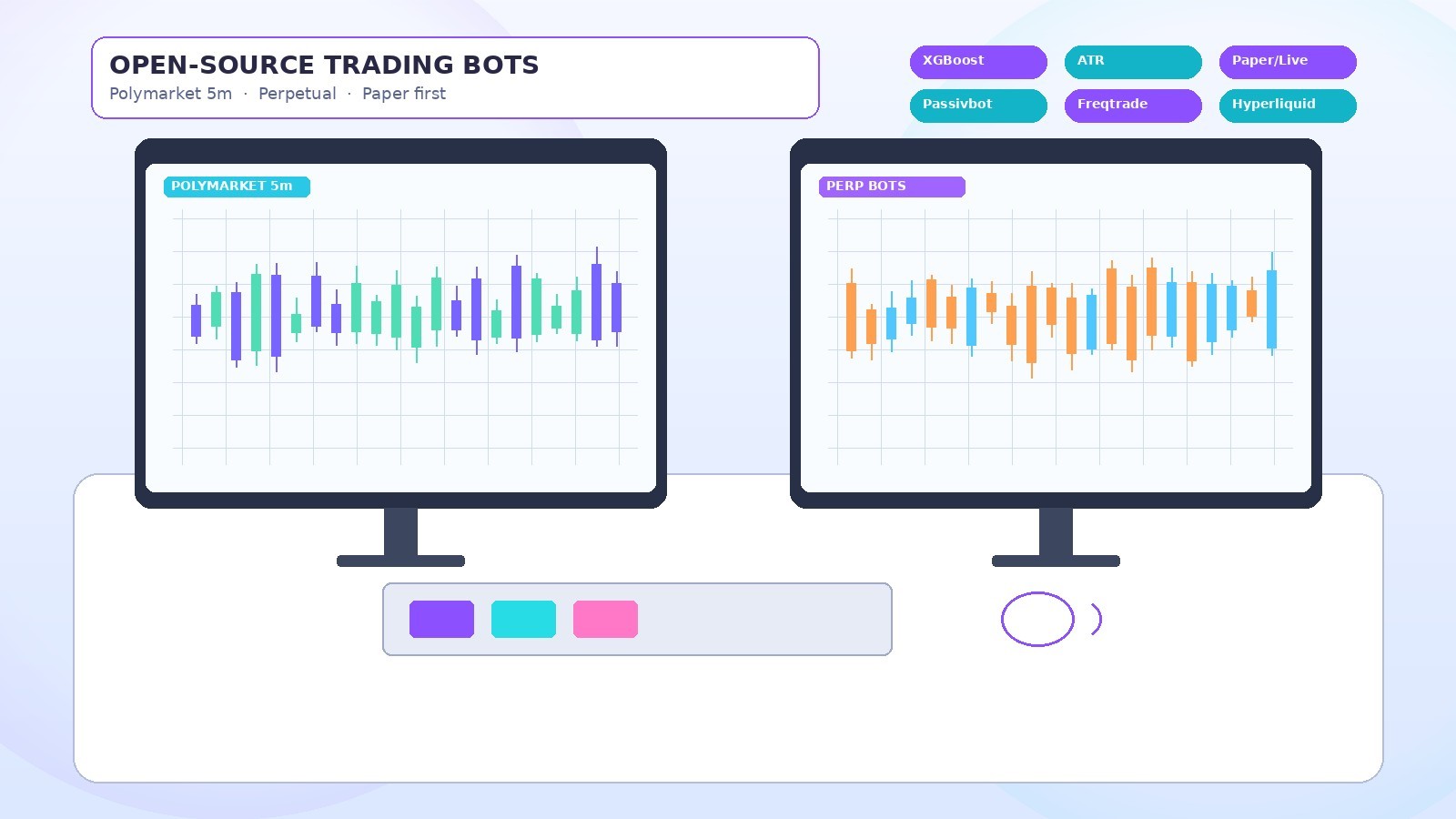
If you are still watching markets by hand, it helps to study a few public repositories first. This list splits into two blocks: Polymarket five-minute Up/Down short-horizon trading, and bitcoin / major-coin perpetuals. Paper first; live later.
Polymarket five-minute Up/Down
Short windows, dense competition—and the place where fees, latency, and adverse selection most often turn a pretty backtest into a mediocre live book. Among public repos, at least three implementations spell out a clear idea.
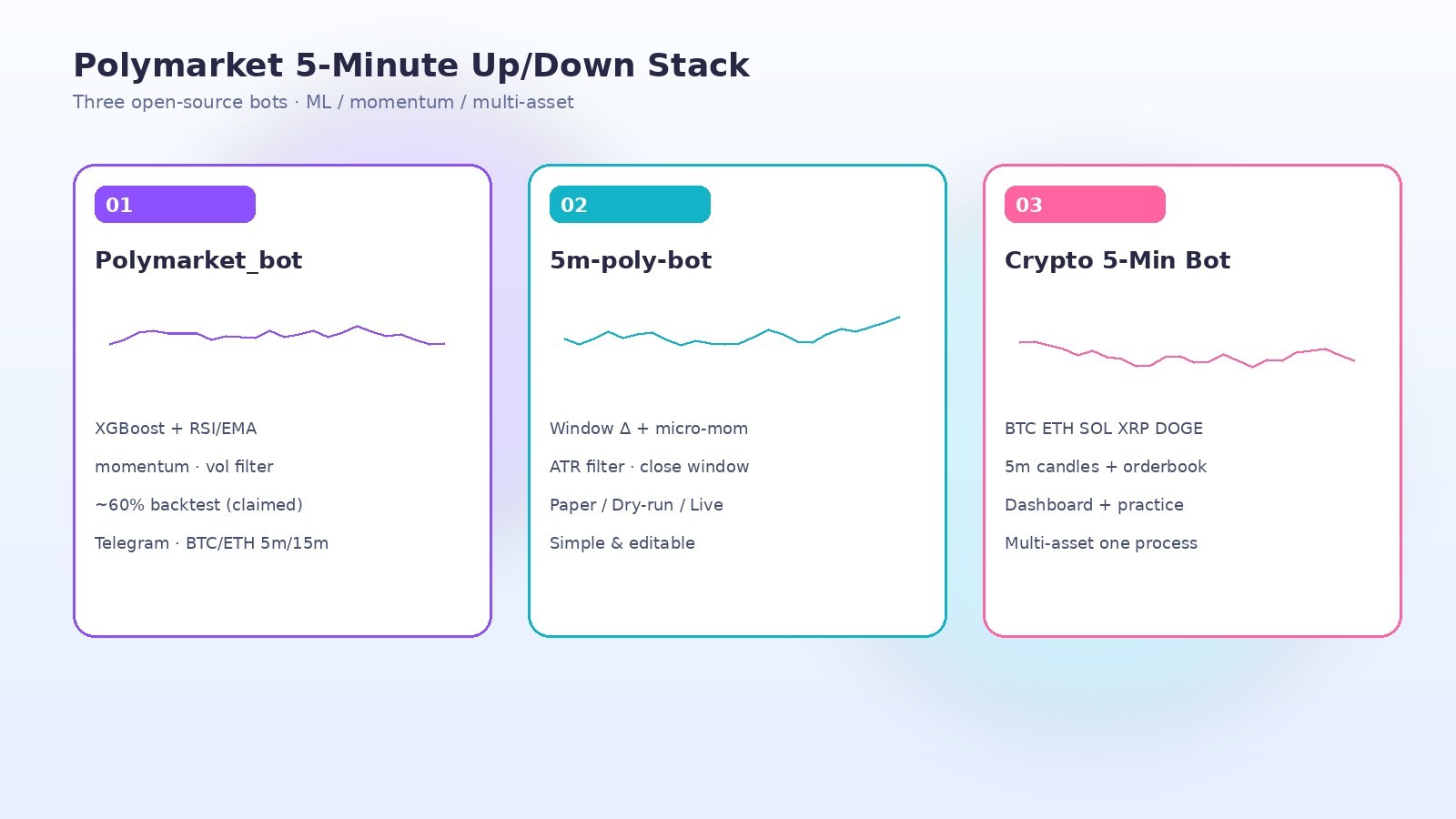
Polymarket_bot (repo Mrpablo98/Polymarket_bot) runs a dual engine: XGBoost on one side, multi-indicator resonance (RSI, EMA, momentum, volatility) on the other. Targets are mainly BTC and ETH five- and fifteen-minute markets; position sizing is rule-based, with cooldown after losing streaks and Telegram alerts. Project materials cite a backtest win rate around sixty percent—that is a claimed figure, not a result reproduced here. Useful if you want analysis and auto-execution in one stack.
5m-poly-bot (repo jmazzini/5m-poly-bot) is shorter-horizon: window delta, micro-momentum confirmation, ATR as a volatility filter, entries only near the close of the window. Modes include Paper, Dry-run, and Live. The code is easy to fork if you first want the short-window logic working end to end.
Polymarket Crypto 5-Minute Bot (repo dearolaf/Polymarket-Crypto-5Minutes-Trading-Bot) covers several coins at once (BTC, ETH, SOL, XRP, DOGE, and others), using five-minute candles plus order-book signals, with a dashboard and practice mode. Worth a look when you do not want a separate process per asset.
In the same lane, public discussion also points to momentum scoring, latency-arbitrage ideas, and a Rust multi-strategy toolkit (five- / fifteen-minute arb, copy-trading-style modules, and more). Search for Prediction-Markets-Trading-Bot-Toolkits (repos often carry a HarrierOnChain-style prefix) and read the docs yourself.
Perpetuals: market-making grids and mature frameworks
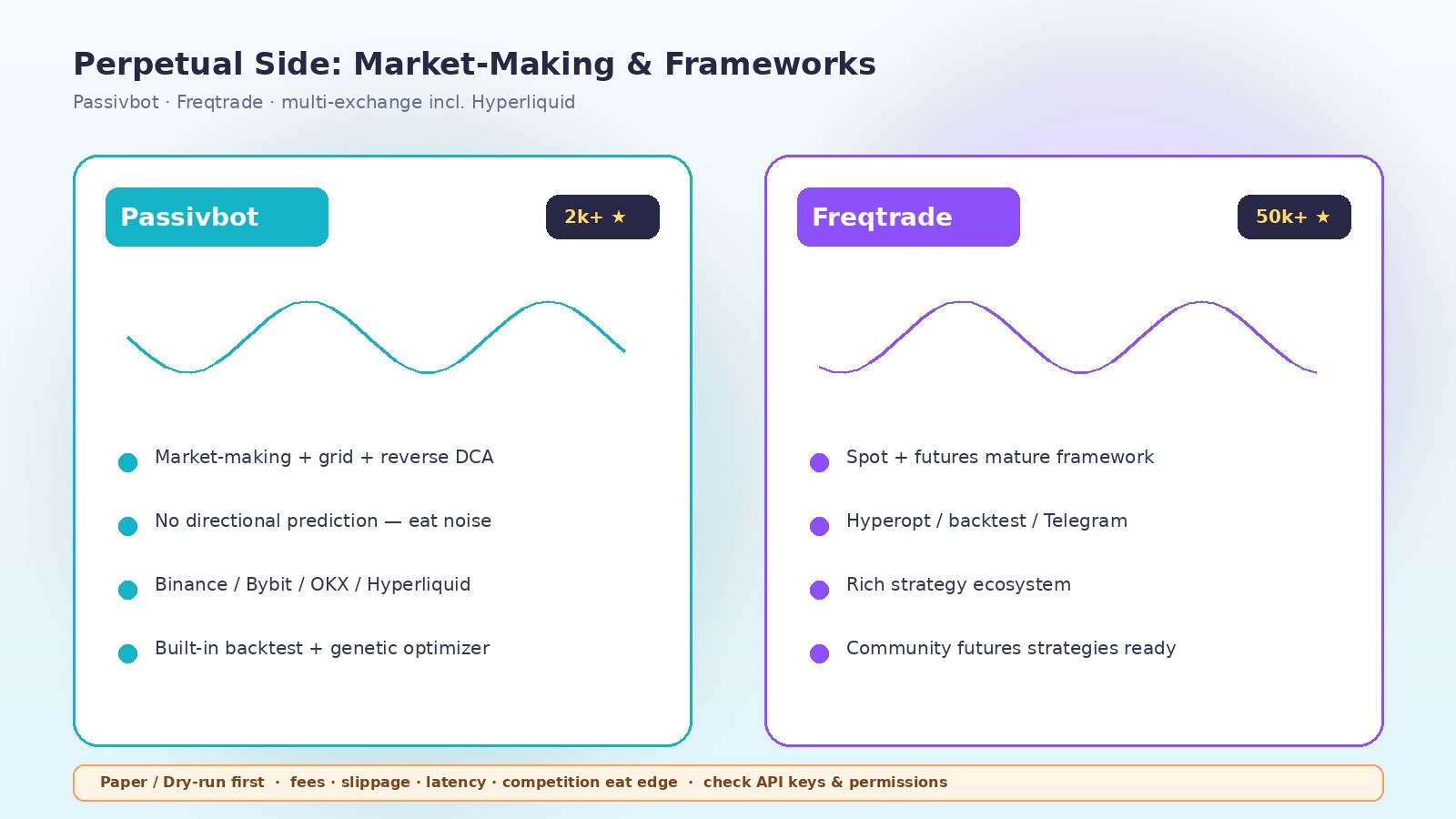
Passivbot (repo enarjord/passivbot, roughly two-thousand public stars) leans market-making, grids, and counter-trend DCA: it does not bet direction so much as harvest noise through spreads and refill cadence. Exchange coverage includes Binance, Bybit, OKX, Hyperliquid, and others, with built-in backtests and genetic-algorithm optimization. People who prefer “passive harvest of volatility” usually start here.
Freqtrade (repo freqtrade/freqtrade, roughly fifty-thousand public stars) is a long-standing spot-and-futures framework with a mature ecosystem: Hyperopt, backtesting, and Telegram control. If you want to write your own strategy—or reuse community futures strategies—most builders still start here; venue coverage likewise includes major CEXs and Hyperliquid-class venues.
Boundaries
Most of these repos are research-grade open source. A clean backtest equity curve is not the same as profit after fees, slippage, latency, and adversarial flow. Accumulate samples in Paper / Dry-run first, validate with small size, and audit key / API permissions separately—grant only what is needed; do not wire withdrawal keys into scripts.
Past performance does not imply future results. Win rates and star counts in this piece follow each repo’s public materials; this outlet makes no return promises.